US Remittance Tax 2026 Explained: Who Pays the 1% Tax, What Is Exempt, and How to Avoid It Legally
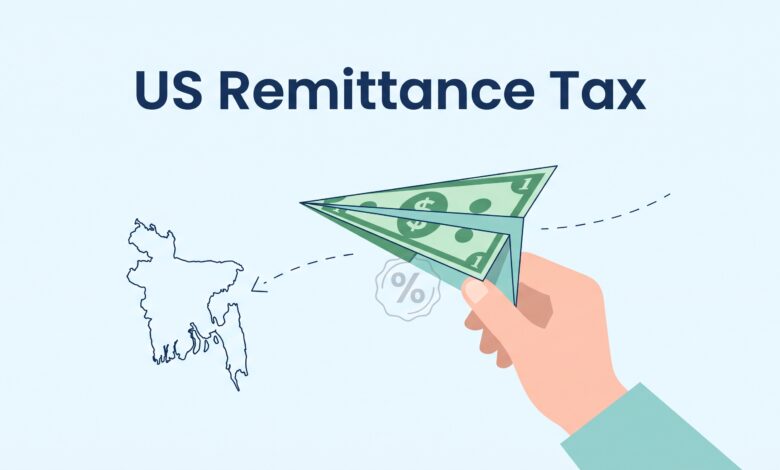
Only money transfers made from the United States to another nation that are paid for with cash, money orders, or cashier’s checks are subject to the 1% federal excise tax known as the US remittance tax. It went into effect on January 1, 2026. The money transfer company must collect the tax at the time of the transaction, and the sender must pay it. Most people who send money through an app or online service will never pay it because transfers made with a bank account, debit card, or credit card are exempt.
That is the short answer. Since this tax was first proposed, rumors, confusion, and out-of-date information have surrounded it, so a longer response matters. Social media is still replete with claims based on the law’s early drafts, which differed greatly from the final version. This guide outlines the law’s precise provisions, who must pay and who doesn’t, how the tax is collected, the changes made to IRS regulations in April 2026, and the legal actions you can take to keep your transfers exempt.
What Is the US Remittance Tax?
The One Big Beautiful Bill Act (OBBBA), which took effect on July 4, 2025, established Section 4475 of the Internal Revenue Code, which includes the remittance transfer tax. For transfers made after December 31, 2025, the statute levies a tax equal to one percent of the total amount of any covered remittance transfer.
The entire law is defined by three points, from which everything else derives. First, it is not an income tax but an excise tax on a transaction. It has nothing to do with how you made the money, your immigration status, or your tax return. Second, it depends on how much you send. If you send $1,000 in a covered transaction, the tax is $10 in addition to the provider’s current exchange rate and transfer fees. Third, and perhaps most crucially, the tax applies only to transfers in which the sender gives the transfer provider cash, a money order, a cashier’s check, or another comparable physical instrument. The funding method determines whether the tax is applicable, not the sender’s citizenship, destination, or amount.
Who Has to Pay the Remittance Tax?
Regardless of citizenship or immigration status, anyone who funds an international transfer using a covered payment method must pay it. This is one of the most misunderstood aspects of the law. The final version of the bill that passed applies to all senders, including US citizens, while earlier versions applied only to non-citizens. The House version that passed in May 2025 proposed a 3.5% tax with an exemption pathway for US citizens using approved providers; however, that citizenship-verification scheme was eliminated before the bill became law. Whether you have a student visa, an H-1B visa, a green card, or a US passport, you still owe the 1% if you pay with cash at a counter.
Two boundaries limit who is impacted. The Electronic Fund Transfer Act, which defines a remittance transfer provider as an individual who provides remittance transfers to customers in the regular course of business, provides the law’s definitions. As a result, this tax targets consumer transfers, and regular business-to-business payments typically do not fall under this definition. The same consumer-protection definition also excludes small-value transfers of $15 or less, so pocket-change transfers are not covered. Additionally, the tax is assessed on the sender in the United States; the overseas recipient is not required to make any payments.
Business Lawyer Degree Requirements Explained
Which Transfers Are Taxed?
Only remittance transfers in which the sender gives the transfer provider cash, a money order, a cashier’s check, or any other comparable physical instrument are subject to the tax. In practice, this refers to the traditional walk-in transaction: using paper money to pay for an international transfer at a bank teller, corner store, or agent counter. It covers purchasing a money order and using it to fund a transfer. Cashier’s checks are covered as well.
For instance, if you give $1,000 in cash to an agent location to send overseas, the tax will add $10 to your cost. You will see the line item before you confirm the transaction because the provider adds it at checkout, the same way sales tax appears on a receipt.
Top 10 Selling Products Online – What People Buy the Most
Which Transfers Are Exempt?
The vast majority of transfers are covered by exemptions, which IRS regulations expanded beyond the original statute in April 2026. Transfers made with a debit card or credit card issued in the US, as well as withdrawals from accounts at regulated US financial institutions, are exempt under the statute itself. The IRS then went one step further: the proposed regulations exempt transfers made with personal checks and general-use prepaid cards, as well as transfers funded by any credit or debit card, regardless of the country in which the card was issued.
Because most articles on this subject are either silent or inaccurate here, that final point merits emphasis. Since a check is physical paper, the statute’s use of the term “similar physical instrument” raised real questions about personal checks. The proposed regulations resolved this in favor of the sender: a personal check draws from a bank account, and Congress specifically decided not to tax account-funded transfers.
Here is the full picture in one place:
| How you fund the transfer | 1% tax? |
|---|---|
| Cash at an agent location or counter | Taxed |
| Money order | Taxed |
| Cashier’s check | Taxed |
| Bank account transfer (ACH, online banking, wire funded from your account) | Exempt |
| US-issued debit or credit card | Exempt |
| Foreign-issued debit or credit card | Exempt under the April 2026 proposed regulations |
| Personal check | Exempt under the April 2026 proposed regulations |
| General-use prepaid card | Exempt under the April 2026 proposed regulations |
| Digital app funded by bank account or card (Wise, Remitly, Xoom, Taptap Send, and similar) | Exempt |
This is why the main digital providers have assured their customers that they are unaffected by the tax. Remitly states that because it is a fully digital service, its transfers are exempt from the tax; Wise has confirmed the same, since the tax does not apply to any of its available payment methods. If your money moves from your bank account or card into an app, you are completely outside the tax.
How Much Will You Actually Pay?
The calculation is straightforward for those who do pay: 1% of the amount sent. A $200 cash transfer carries a $2 tax. A $1,000 cash transfer carries $10. A $5,000 transfer made with a cashier’s check carries $50. This tax stacks on top of the provider’s transfer fee and the exchange rate margin — the hidden cost built into the rate you are offered.
Here is the perspective an honest analysis must include: for many senders, the exchange rate margin costs far more than this tax ever will. A provider offering a rate 3% worse than the mid-market rate takes $30 of every $1,000, three times the remittance tax, and it is never itemized on the receipt. If this new tax finally pushes you to compare providers on total cost, you may end up saving money on net. The tax is the visible cost; the rate margin is the invisible one, and it is usually bigger.
How Is the Tax Collected?
Senders don’t file anything, and there is no form to fill out. The transfer provider must collect the tax from the sender at the time of the transfer, make semimonthly deposits, and file quarterly returns with the IRS, and if the provider fails to collect it, the liability shifts to the provider itself. This secondary-liability rule is why providers have been strict about adding the charge at checkout since January.
One operational detail shapes how this feels at the counter. The proposed regulations make clear that agents of remittance transfer providers- a grocery store acting as an agent is the example the regulations use- are not themselves required to collect the tax, although in practice the contracts between agents and providers typically require agents to collect all applicable fees and taxes. So expect the 1% to show up on cash transactions whether you are at a dedicated branch or a corner-store agent.
The IRS also granted penalty relief for failures to deposit the tax during the first three quarters of 2026, acknowledging that providers needed time to build these systems. That suggests the agency expects uneven compliance this year, and it tells senders to check receipts, since collection errors are possible in either direction during the transition.
Why Did Congress Pass It?
Over ten years, the Joint Committee on Taxation projects the tax will generate about $10 billion in federal revenue. The final design is much narrower than what was first discussed: the proposed rate began at 5% during Congressional debate before settling at the final 1%, and the scope was reduced to cash-like instruments only, leaving regular bank-based transfers untouched.
Supporters framed the measure as a modest levy that raises revenue and encourages moving funds from anonymous cash channels to traceable electronic ones. Critics, including the governments of major recipient countries, argued that it functions as a tax on immigrant workers supporting families overseas, that it burdens the unbanked who have no option but cash, and that even a small per-transfer cost compounds across millions of low-income households.
Mexico’s president publicly opposed the tax from the moment it was proposed and responded by promoting a government-backed card that lets Mexican nationals in the US send money electronically and avoid the cash penalty. Both readings of the law can be true at once,what is not in dispute is that anyone with a bank account or card can route around it, so the burden concentrates on those who cannot.
State Remittance Taxes Are Stacking on Top
The federal tax is no longer the whole picture. Tennessee became the second state after Oklahoma to pass its own tax on international money transfers in May 2026: when the law takes effect in 2027, senders in Tennessee will pay a $10 fee on transfers under $500 and an additional 2% on amounts over $500, on top of the federal remittance tax and normal transfer fees. Unlike the federal version, these state-level charges are not necessarily limited to cash funding, which makes them potentially far more expensive for ordinary senders. If you live in Oklahoma or Tennessee, review the state rules independently, and more states will likely follow now that two have moved.
Is the Tax Changing How People Send Money?
The early evidence says yes, in exactly the direction the law’s design predicted. A major provider projected the tax would reduce remittances by roughly 1.6 percent, and Mexico, which received $62.5 billion in remittances in 2024, saw transfers fall 5.5 percent in the first nine months of the year compared with the prior year. Providers, meanwhile, are actively marketing the exemption: digital-first companies have built entire campaigns around the fact that switching from a cash counter to an app makes the tax disappear. The most likely long-term effect of this law is not the revenue it raises but the acceleration of a shift that was already underway, from cash agents to digital transfers.
What This Means If You Send Money to Bangladesh
Bangladesh is one of the corridors where this question matters most. The country received a record $35.56 billion in remittances in fiscal year 2025–2026, a 17.3 percent increase over the previous year, and the United States is one of its largest sources. The practical impact splits cleanly into two groups.
If you already send through Wise, Remitly, Taptap Send, Xoom, or a bank transfer to a Bangladeshi account or bKash wallet, nothing changes for you. Your funding method is exempt, and you will not see the 1% line. If you send by handing cash to an agent,still common among newer arrivals and workers paid in cash, every transfer now costs an extra 1%, and switching to an app funded by even a basic US bank account eliminates it immediately.
On a typical $500 monthly transfer home, that is $60 a year recovered by changing nothing except the payment method. Combine the switch with choosing the provider offering the best taka rate that week and the savings multiply, because the rate spread between providers on the USD to BDT corridor is routinely larger than the tax itself.
How to Avoid the Remittance Tax Legally
Congress wrote the exemption into the law itself, so you don’t need clever structuring to avoid this tax: fund your transfer electronically. If you currently pay with cash at a counter, open a basic bank account, many US banks offer accounts with no minimum balance, and several accept an ITIN in place of a Social Security number, and fund your transfers from that account or its debit card. If you prefer in-person service, you can still visit the same agent location; using your debit card there instead of cash keeps the transfer exempt. If you are comfortable with apps, the digital providers are exempt across the board and are usually cheaper on fees and exchange rates too.
One caution belongs here. The law includes anti-conduit rules, under which the IRS considers all facts and circumstances when determining whether a series of transactions was designed to avoid the tax, Congress anticipated that people might try to disguise taxable cash transfers through intermediate steps. Handing cash to a middleman who then sends it “digitally” on your behalf is the kind of arrangement those rules exist for. The legal path is simpler anyway: put the money in an account first, then send it. Depositing your own cash into your own bank account and transferring from there is ordinary banking, not a conduit scheme.
Common Misconceptions, Corrected
The amount of misinformation on this topic is remarkable, largely because the law changed so much between proposal and passage. It is not a 5% tax that the early figure died in Congress. It is not a tax only on immigrants; citizenship is irrelevant in the final law. It is not a tax on receiving money; funds arriving in the US from abroad are untouched, and the recipient abroad owes nothing. It does not apply to every transfer app by default; it applies to no mainstream app funded by bank or card. It is not deducted from the amount your family receives; it is charged to you at the point of payment, on top. And it is not an income tax or a reporting obligation; senders never have to file anything.
Frequently Asked Questions
Does the remittance tax apply to Wise, Remitly, or Western Union online transfers?
No. These services are funded by bank account, debit card, or credit card, all of which are exempt. The tax applies only when you pay with cash, a money order, or a cashier’s check at a physical location.
Do US citizens have to pay the remittance tax?
Yes, if they fund an international transfer with cash or a cash-like instrument. The final law applies to everyone, including US citizens, the citizenship exemption existed only in earlier drafts that never became law.
Is there a minimum amount before the tax applies?
The 1% applies to covered transfers regardless of size, though transfers of $15 or less are excluded under the borrowed legal definition. There is no upper limit; a $10,000 cash-funded transfer carries a $100 tax.
Are personal checks taxed?
No, the April 2026 proposed regulations exempt transfers purchased with checks, resolving the ambiguity in the statute’s “similar physical instrument” language.
What about foreign-issued cards?
The statute exempted only US-issued cards, but the proposed regulations expanded the exemption to cards regardless of country of issuance.
Does the tax apply to cryptocurrency transfers?
Current guidance treats bank transfers, US cards, and cryptocurrency as outside the tax, since the tax is triggered only by physical funding instruments. Crypto has its own tax rules on gains, which is a separate matter.
When exactly did it start?
It applies to transfers made on or after January 1, 2026.
Could the rate go up later?
The rate is set at 1% by statute, and only Congress can change it. Given that the original proposals were as high as 5%, future increases are politically possible but purely speculative. The nearer-term change to watch is the finalization of the IRS regulations, with final rules anticipated by the end of the year.
I live in Tennessee or Oklahoma, what changes for me?
You face state-level transfer taxes in addition to the federal one. Tennessee’s law, effective 2027, adds a $10 fee on transfers under $500 and 2% on amounts above that. Check the state rules before choosing how and where you send.
The Bottom Line
For most readers of this article, the US remittance tax is real, operative, and, by design,avoidable. It affects only transfers made with cash, money orders, and cashier’s checks; every electronic funding pathway is exempt, and the April 2026 regulations expanded these exemptions further to include personal checks, prepaid cards, and foreign-issued cards. When sending money overseas, the only thing that matters is how the transfer is funded. If the answer is a bank account or card, this tax is not your problem. If the answer is cash at a counter, switching to an account-funded method will almost certainly reduce your fees, improve your exchange rate, and eliminate the tax today.